
What if the secret to a high-impact brand isn't in the number of photos you keep, but in the ones you have the courage to cut? It’s a common frustration to feel a wave of analysis paralysis when your professional gallery arrives. You might find yourself caught between a technically flawless shot and one that feels more authentic; perhaps you're worried about minor imperfections that nobody else will ever notice. Understanding how to select the best photos from a gallery is less about finding perfection and more about identifying the visual assets that will actually drive your narrative forward.
We understand that being the subject of a professional shoot can feel vulnerable. It's natural to be critical of yourself, yet your audience craves the very authenticity you might be tempted to filter out. This guide promises to transform your culling process from a chore into a strategic editorial act. We'll provide a streamlined workflow to help you distinguish between technical quality and emotional impact. By the end, you'll have the confidence to finalise a gallery that doesn't just look sophisticated, but functions as a vital investment for your personal brand or fashion portfolio.
Key Takeaways
- Shift your perspective from simply picking pictures to curating a strategic brand asset that drives professional growth and market presence.
- Adopt the systematic Three-Pass Method to efficiently narrow down hundreds of images into a cohesive, high-impact final selection without analysis paralysis.
- Master how to select the best photos from a gallery by balancing technical precision with the emotional resonance of authentic micro-expressions.
- Identify the functional value of each image to ensure your final selection serves a specific marketing purpose across your digital and social platforms.
- Learn how to leverage a collaborative alliance with your photographer to refine your visual identity during the final retouching and curation phase.
The Psychology of Choice: Why Selecting Photos Feels Overwhelming
Opening a professional gallery for the first time often triggers a specific type of anxiety. You've invested in a session to elevate your professional presence, and now you face hundreds of frames that all look, at first glance, exceptional. This is where analysis paralysis takes hold. It isn't just about the volume of work. It’s about the psychological weight of knowing these images will represent your brand for months or years to come. You aren't just picking pictures; you're deciding how the world perceives your authority.
The 'Paradox of Choice' in Digital Galleries
Psychologists often cite the 'Paradox of Choice' when explaining why we struggle with abundance. When you see twelve slightly different versions of the same pose, your brain essentially stalls. Instead of identifying the "best" shot, you start looking for reasons to discard others. This decision fatigue is why the first ten minutes of viewing are often your least productive. You're reacting to the sheer volume rather than strategising. To maintain a fresh perspective, we suggest the following:
- Limit your initial sessions. Don't try to cull everything in one sitting.
- Close the tab. If you feel frustrated, walk away for an hour.
- Focus on the "Yes" list. Don't worry about why a photo is a "No" yet.
Taking breaks allows you to stop obsessing over minute differences. It helps you refocus on how to select the best photos from a gallery that actually serves your business goals rather than just your personal preference.
Emotional Attachment vs. Technical Excellence
There is a constant tension between the 'artist’s eye' and the 'subject’s insecurity'. As the subject, you might focus on a perceived facial flaw or a minor blemish that no one else will ever notice. Meanwhile, the photographer sees a perfect composition or a lighting setup that communicates power and reliability. You might favour a photo because it reminds you of a joke shared during the shoot, whilst a different frame actually projects more confidence to a potential client.
You must learn to detach personal sentiment from functional requirements. A photo that isn't your personal favourite angle might be the exact one that fits your website's hero banner perfectly. This is why a 'third-party' perspective is so valuable. Whether it's a trusted colleague or your photographer, an outside eye sees the image as a strategic asset. They see the mood and the narrative, not the internal critique you carry about your own appearance. Stop looking for perfection; perfection is a myth that kills progress. Instead, look for the images that function as tools for your growth.
A Professional Selection Framework: The Three-Pass Method
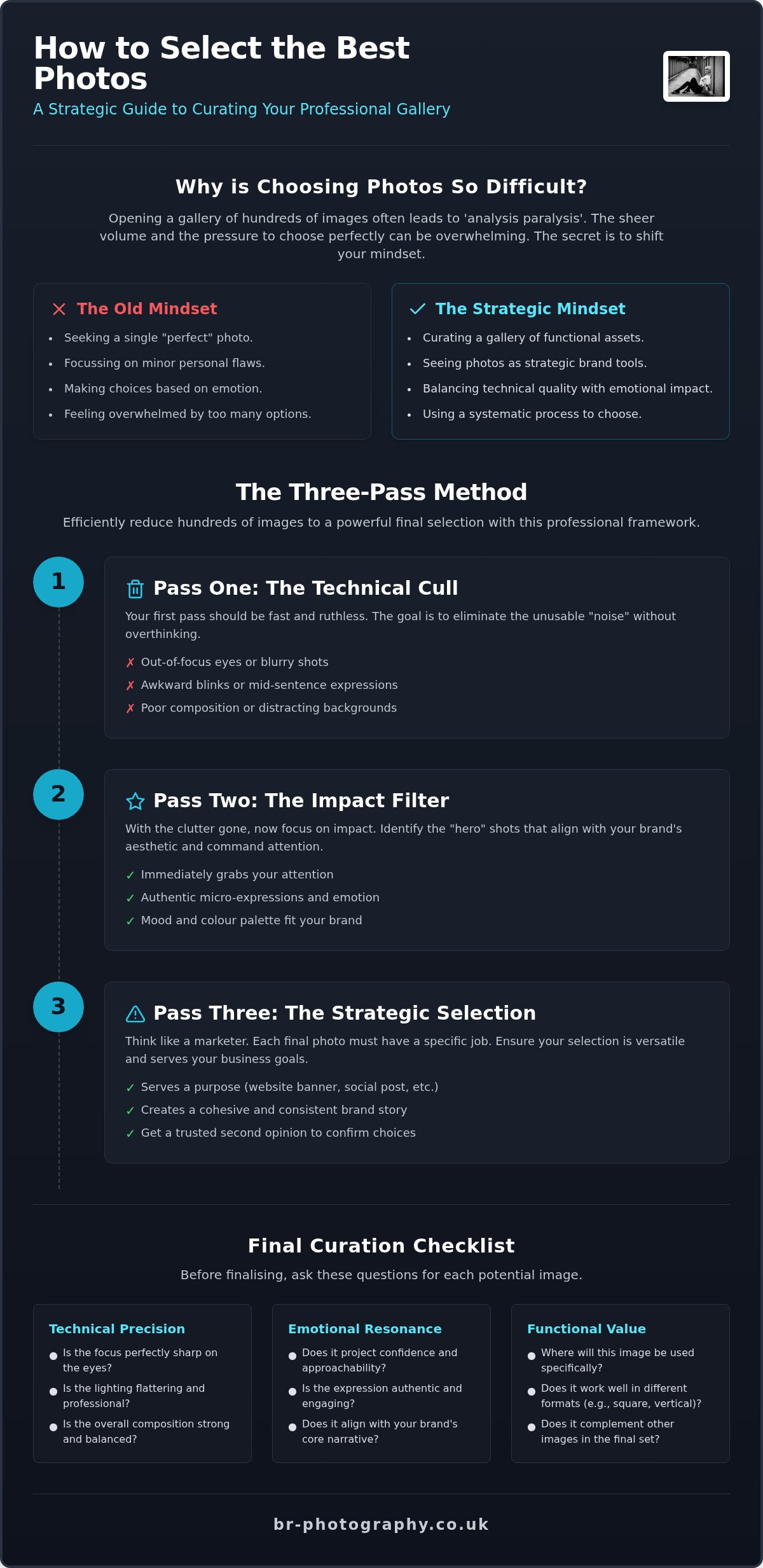
The Three-Pass Method serves as a rigorous editorial filter for visual quality, moving you from initial overwhelm to a curated collection of high-value assets. Attempting to choose your final images in a single sitting often leads to poor decision-making and mental fatigue. By breaking the process into distinct phases, you transition from a reactive state to a strategic one. This framework allows you to reduce a gallery of 200 plus images to a core selection of 20 with precision and speed. It's essential to keep your workspace organised; use the gallery's internal flagging or 'favourite' tools to track your progress without permanently deleting anything in the early stages.
The First Pass: Eliminating the Technical 'Garbage'
Your first pass should be fast. You aren't looking for perfection yet; you're simply removing the noise. Be ruthless with technical failures that can't be salvaged in post-production. This includes out-of-focus eyes, awkward blinks, or those mid-sentence expressions that feel unpolished. If you have five nearly identical frames of the same pose, pick the one with the most balanced composition and flag it. Don't overthink the "why" at this stage. Use a simple binary "Yes" or "No" approach to clear the clutter. Mastering how to select the best photos from a gallery begins with this high-speed culling of obvious rejects.
The Second Pass: Categorising the 'Strong Contenders'
Now that the technical distractions are gone, shift your focus to impact. This pass is about identifying your "hero" shots, those images that immediately command attention and align with your professional aesthetic. Evaluate the colour palette and the mood of each frame against your intended use cases. Are you looking for a bold hero image for a website banner, or a softer, more approachable shot for social media? Group your remaining images by outfit, location, or general "vibe". This ensures you don't end up with ten great photos that all look exactly the same. If you find yourself struggling to remain objective, you might discuss your brand goals with us to help narrow the field.
The Third Pass: Final Culling for Narrative Flow
The final pass is the most strategic. You are no longer just looking for "nice" shots; you are building a narrative. Select the best one or two images from each sub-group created in the previous pass to avoid redundancy. Your final gallery should tell a cohesive story of your brand or portfolio. Perform a final "gut check" on these remaining frames. Do they feel like the most authentic version of you? If an image is technically perfect but feels "off" or performative, cut it. Your audience will sense that lack of authenticity. The goal is a streamlined set of visual assets that function as a powerful investment in your professional future.
Beyond Aesthetics: Selecting Photos for Personal Branding and Impact
Personal brand photography is a strategic business investment. It differs fundamentally from traditional portraiture. Whilst a standard portrait seeks a flattering likeness, a personal brand asset must perform a specific task within your marketing ecosystem. When you consider how to select the best photos from a gallery, you must move beyond the mirror. Stop asking if you look "perfect" and start asking if you look "capable." Every choice should align with your brand's core values and the professional expectations of your specific industry.
Evaluating Composition for Versatile Digital Use
A common mistake is selecting images based solely on your facial expression. In a professional context, you must evaluate the architecture of the frame. Look for "crop-friendly" images. A wide shot with ample negative space is often more valuable than a tight headshot. This space allows for text overlays, call-to-action buttons, and flexible website hero banners. Your posture and eye contact must also align with the intended message of your landing pages. A warm, empathetic glance is perfect for a "Work With Me" section, whilst a more direct, focused gaze conveys the authority needed for a keynote speaker profile.
Authenticity Over Perfection: Choosing the 'Right' Expression
Authenticity is the currency of the modern market. A slightly "imperfect" laugh or a candid moment of focus often converts better than a stiff, rehearsed smile. These micro-expressions signal approachability and build immediate trust with your audience. If you are an entrepreneur in a high-stakes sector, the strategic use of urban portrait photography can signal a modern, trend-aware identity. It shows you are active and relevant. Don't fear the shots that feel less "posed." These are often the ones that capture your personality in a way that feels genuine to your clients. Knowing how to select the best photos from a gallery means choosing the image that starts a conversation before you have even met the viewer.
Technical Red Flags and Hidden Gems: What to Look For
Once you have moved past the initial emotional reaction to your gallery, it's time to apply a more clinical lens. Understanding the technical mechanics of a shot helps you distinguish between a masterpiece and a mistake. Identifying how to select the best photos from a gallery requires you to recognise which elements are deliberate creative choices and which are genuine deal-breakers. High-end imagery relies on a foundation of technical precision that even the best post-production cannot always salvage.
The Deal-Breakers: Focus, Lighting, and Distractions
Focus is the non-negotiable anchor of a professional portrait. In almost every instance, the eyes must be tack-sharp. If the focus has drifted to the tip of the nose or the background, the image will feel "off" to the viewer, even if they cannot quite articulate why. Whilst modern editing can soften skin or adjust tones, it cannot manufacture clarity where the camera missed the mark. You should also be wary of "blown-out" highlights where detail in the brightest areas is completely lost, or harsh, unflattering shadows that bisect the face in an unappealing way. These lighting issues can often pull focus away from your professional presence.
- Check the iris. Zoom in to ensure the eyes are crisp and clear.
- Scrutinise the background. Look for "mergers," such as a stray object appearing to grow out of your head or shoulder.
- Spot the shake. Distinguish between intentional "artistic blur," used to create depth, and accidental camera shake, which leaves a ghosted, messy edge on the entire subject.
Recognising the 'Happy Accidents' and Candid Moments
The most technically perfect shot isn't always the most effective one. Often, the true "hidden gems" are found in the seconds between poses. These candid moments capture a micro-expression, such as a genuine laugh, a thoughtful glance away, or a subtle adjustment of a jacket, that conveys more character than a rehearsed smile ever could. These images possess an "energy" that feels alive rather than static. They signal authenticity, which is a vital asset for entrepreneurs and fashion brands alike. If a frame feels emotionally resonant, don't discard it just because it isn't a traditional pose. If you are unsure which candid shots best represent your professional identity, we invite you to book a consultation to review your gallery with our creative team.
Ultimately, a successful selection balances these technical standards with emotional impact. A photo with slight movement might actually be superior if it captures a sense of modern, fast-paced leadership. Learn to value the "in-between" moments. They are often the frames that your audience will find most relatable and trustworthy in a competitive market.
Turning Selection into Strategy: Finalising Your Gallery with BR-Photography
Finalising your selection is the point where your creative vision meets technical execution. By now, you've applied the professional filters discussed in previous sections. You've moved beyond personal insecurities and focused on functional value. The final step is not just about ticking boxes; it's about ensuring your chosen assets are ready for the high-stakes environment of modern digital marketing. When you understand how to select the best photos from a gallery, you provide your photographer with the raw material needed to craft a truly bespoke visual identity. This is where your investment begins to yield tangible results.
Organising Your Final Selection for Maximum Utility
A successful shoot produces a diverse range of assets. It's vital to organise these with future use-cases in mind. We recommend categorising your final picks by their intended platform. Create specific folders for your website, social media, and press releases. This saves time and ensures you always have the right image for the right context. Ensure you have a balance of orientations; a beautiful portrait-oriented shot might fail as a website hero banner if it doesn't allow for the necessary horizontal crop.
- Website Hero Images: Prioritise landscape orientations with ample negative space for text overlays and call-to-actions.
- Social Media Assets: Focus on high-energy, vertical crops that feel approachable and authentic for mobile scrolling.
- Press and Speaking Profiles: Select high-authority headshots that project confidence and expertise for professional bios.
- Lifestyle Content: Use the candid 'hidden gems' to build trust and relatability amongst your target audience.
The Collaborative Advantage of Professional Culling
Whilst the initial culling is a personal journey, the final stage functions best as a collaborative alliance. Leveraging a professional eye can reveal potential in frames you might have overlooked. Brian Rothery’s expert eye allows for a deeper analysis of how an image will perform once retouched. An expert can spot a micro-expression that aligns perfectly with current industry aesthetics, even if the raw file looks unfinished to the untrained eye. This partnership ensures your choices are not just 'nice' photos, but strategic assets designed for business growth. Knowing how to select the best photos from a gallery involves trusting this professional feedback loop to refine your brand's narrative.
Professional retouching is the final layer of polish. It’s the essential investment that elevates a great shot into a world-class brand asset. This process should always be a reflection of your authentic self, enhanced for professional clarity rather than artificial perfection. Once your selection is finalised and the retouching is complete, you aren't just left with a set of pictures. You have a powerful, cohesive visual identity ready to command attention in your sector. Your gallery is no longer a collection of moments; it is a strategic tool for your professional future.
Elevate Your Professional Narrative with Strategic Selection
Curating your final gallery is the definitive step in transforming a creative session into a long-term business asset. By moving beyond the initial friction of self-critique and adopting a structured Three-Pass Method, you ensure every chosen frame serves a specific marketing purpose. You've learned that technical precision is the foundation, but emotional resonance and authenticity are what truly build trust with your audience. Mastering how to select the best photos from a gallery allows you to stop seeing your images as mere pictures and start seeing them as strategic tools. It's about building a visual legacy that reflects your ambition.
As a strategic partner for personal branding, BR-Photography specialises in fashion-forward aesthetics and urban portraiture that capture your unique professional energy. Our nationwide service across the UK is designed to help you build a visual identity that drives growth. Book a strategic personal brand session with BR-Photography to begin your collaborative journey today. Your brand deserves a powerful visual story that works as hard as you do.
Frequently Asked Questions
How many photos should I typically select from a full gallery?
You should aim for a curated selection of 15 to 25 images that cover your essential marketing needs across various platforms. Whilst it’s tempting to keep every 'nice' shot, a smaller set of high-impact assets ensures your brand remains cohesive and professional. Focus on variety across different outfits and locations to maximise the functional utility of your visual investment.
What is the difference between culling and editing in photography?
Culling is the strategic act of selecting the strongest frames, whilst editing refers to the technical post-production work that follows. When you learn how to select the best photos from a gallery, you are acting as an editor, applying a narrative filter to the work. Editing involves the photographer refining the colour, lighting, and texture of those chosen assets to create a polished result.
Can a blurry photo ever be considered a 'best' photo?
A blurry photo can be exceptional if the blur is intentional and adds a sense of movement, energy, or raw emotion. This 'artistic blur' is a hallmark of modern fashion and urban portraiture, creating a dynamic feel that static shots lack. However, accidental camera shake that leaves the subject looking messy or ghosted is a technical error that should be discarded during your first pass.
Should I ask friends or family for their opinion on my gallery selection?
We suggest seeking feedback from professional colleagues or your photographer rather than friends or family. Loved ones often choose images based on personal memories or 'safe' smiles that don't always align with your commercial goals. A strategic partner will help you identify the specific frames that project authority and resonate with your target audience in a business context.
How do I know if a photo will work well with text for my website?
Look for 'negative space' or areas of low detail where text can sit without clashing with the primary subject. Images with a clean, out-of-focus background are ideal for website banners and hero headers. Consider the direction of your gaze; your eyes should ideally lead the viewer’s eye toward your call-to-action buttons or important copy on the page.
Is it better to choose a flattering photo or a technically perfect one?
The most effective choice is the one that feels most authentic to your professional identity. A technically perfect shot can sometimes feel static or performative, which may distance your audience. If a slightly less 'perfect' photo captures a genuine micro-expression that builds trust and approachability, it will be a far more valuable asset for your brand’s long-term growth.
What should I do if I love two photos that are almost identical?
You must be ruthless and select only one image to maintain a streamlined and impactful gallery. Look for subtle differences in the 'energy' of the eyes or the specific tension in the jawline. Redundancy dilutes the strength of your visual story; picking the single strongest frame ensures every image in your final set has a clear, strategic purpose.
How long does the final retouching process usually take after I make my selection?
The retouching phase typically takes between one and two weeks after you have finalised your choices. This timeframe allows for the meticulous hand-finishing required to elevate your images into high-end brand assets. Understanding how to select the best photos from a gallery promptly helps ensure your project stays on schedule for your upcoming marketing launches or professional press deadlines.
Disclaimer
"The information provided in this Blog post is for general informational purposes only. While I strive to provide accurate information, I make no representations or warranties of any kind about the accuracy, reliability, or completeness of this information. Any reliance you place on such information is strictly at your own risk. In no event will I be liable for any loss or damage derived from the use of this blog."


